Particle accelerators are like giant, complex microscopes that allow us to probe the fundamental building blocks of the universe. They work by using electromagnetic fields to accelerate charged particles to extremely high speeds.
Here's a breakdown of the process:
1. The Starting Point:
* Particles are injected into the accelerator: This can be electrons, protons, or heavier ions. The source varies depending on the type of accelerator and the research being conducted.
* Initial acceleration: The particles are first given a "kick" to get them moving, often using an electrostatic field.
2. The Acceleration Process:
* Electromagnetic Fields: The accelerator utilizes alternating electric and magnetic fields to accelerate the particles.
* Circular or Linear Motion: There are two main types:
* Linear accelerators (linacs): Particles travel in a straight line, gaining energy as they pass through accelerating cavities.
* Circular accelerators (synchrotrons): Particles travel in a circular path, continuously gaining energy with each lap. The magnetic fields guide the particles in their circular path.
3. Achieving High Energy:
* Increased Energy, Increased Speed: The more times the particles pass through the accelerating fields, the faster and more energetic they become.
* Reaching the Target: The high-energy particles are then directed towards a target, which can be another particle, a material, or a detector.
4. Observation and Analysis:
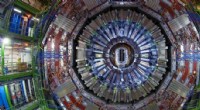
* Detecting Particles: The collisions and interactions of the particles are observed using various detectors, which can be sophisticated instruments capable of capturing even the smallest particles and their properties.
* Analyzing the Data: This data is then analyzed to gain insight into the fundamental laws of physics, the nature of matter, and the origins of the universe.
Key Concepts:
* Electromagnetic Fields: The heart of particle accelerators. They are responsible for accelerating and guiding the particles.
* Energy: The particles gain kinetic energy as they accelerate.
* Speed: The particles reach speeds very close to the speed of light.
* Collisions: Collisions between accelerated particles are used to study the fundamental building blocks of matter.
Beyond the Basics:
Particle accelerators are complex machines with a wide variety of designs and applications. They are essential tools for:
* High-energy physics research: Exploring the fundamental building blocks of matter and forces.
* Medical applications: Creating isotopes for medical imaging and treatment.
* Materials science: Studying the properties of materials at an atomic level.
In Conclusion: Particle accelerators are powerful tools that allow us to explore the microscopic world and understand the universe at its most fundamental level. They are constantly evolving and pushing the boundaries of human knowledge.