Here's why:
* Transverse waves involve oscillations perpendicular to the direction of wave propagation. Think of a ripple in a pond or a wave on a string.
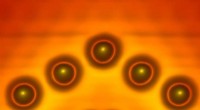
* Standing waves are formed by the superposition of two waves traveling in opposite directions. They appear to be stationary, with points of maximum amplitude (antinodes) and minimum amplitude (nodes).
* Fixed ends are crucial for the formation of standing waves. The waves reflect off the fixed ends, interfering with the incoming wave and creating a standing wave pattern.
Examples of standing waves in fixed mediums:
* A vibrating string: When you pluck a guitar string, the string vibrates to produce a standing wave pattern. The fixed ends are where the string is attached to the instrument.
* A closed pipe: When you blow across the open end of a closed pipe, the air column inside vibrates, forming standing waves. The fixed end is the closed end of the pipe.
* A drumhead: The surface of a drumhead vibrates to produce standing waves. The fixed ends are the edges of the drumhead.
Important Note: While standing waves are associated with fixed ends, it's essential to remember that they are still a combination of transverse waves. The individual waves that form the standing wave are transverse, but the standing wave itself appears stationary.