1. Piezoresponse Force Microscopy (PFM)
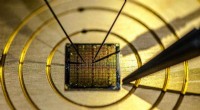
* Principle: This technique utilizes a sharp tip to induce and detect local piezoelectric response in the ferroelectric material. It measures the displacement of the tip due to the electric field generated by the ferroelectric domain.
* Advantages: High spatial resolution, sensitive to local domain structures.
* Limitations: Can be affected by surface topography, requires specialized equipment.
2. Sawyer-Tower Circuit
* Principle: This circuit measures the hysteresis loop of a ferroelectric capacitor. It applies an alternating electric field to the capacitor and measures the corresponding polarization.
* Advantages: Simple and widely used for bulk materials.
* Limitations: Not suitable for thin films due to low sensitivity, requires macroscopic samples.
3. Polarization-Electric Field (P-E) Loop Measurement
* Principle: Similar to the Sawyer-Tower circuit but with more advanced instrumentation. It uses a high-precision electrometer to measure the polarization of a ferroelectric capacitor.
* Advantages: Higher sensitivity than the Sawyer-Tower circuit, suitable for thin films.
* Limitations: Requires specialized equipment and careful sample preparation.
4. Dielectric Spectroscopy
* Principle: This technique measures the dielectric constant of the material as a function of frequency. It can be used to study ferroelectric properties by analyzing the frequency dependence of the dielectric constant.
* Advantages: Provides information about the dielectric properties of the material, suitable for thin films.
* Limitations: Requires specialized equipment and analysis.
5. Second Harmonic Generation (SHG)
* Principle: This technique measures the nonlinear optical response of the material. Ferroelectrics exhibit a strong SHG signal due to their non-centrosymmetric structure.
* Advantages: Sensitive to ferroelectric domain structure, can be used for in situ measurements.
* Limitations: Requires specialized equipment and can be affected by other nonlinear optical processes.
6. X-ray Diffraction
* Principle: X-ray diffraction patterns can reveal the crystal structure and domain orientation of the ferroelectric material.
* Advantages: Provides information about the crystal structure and domain alignment.
* Limitations: Requires specialized equipment and sample preparation.
These are just some of the common techniques used to measure the ferroelectricity of thin films. The choice of technique depends on the specific application and desired information.