Here's a breakdown:
1. Different speeds in different media: Light travels at different speeds in different media. For example, light travels faster in air than in water or glass. This is because the interaction of light with the atoms and molecules in the medium affects its speed.
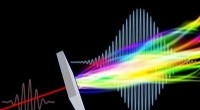
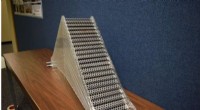
2. Change in direction: When light enters a new medium at an angle, one side of the wavefront (the boundary between the two media) enters the new medium before the other side. Since the light travels slower in the denser medium, the side that entered first slows down before the other side. This difference in speed causes the wavefront to bend, changing the direction of the light.
3. Snell's Law: The amount of bending (the angle of refraction) is determined by the angle of incidence (the angle at which the light strikes the surface) and the indices of refraction of the two media. This relationship is described by Snell's Law:
n₁ sin θ₁ = n₂ sin θ₂
* n₁ and n₂ are the indices of refraction of the first and second media, respectively.
* θ₁ is the angle of incidence.
* θ₂ is the angle of refraction.
In simpler terms: Imagine a car driving on a smooth road and suddenly entering a muddy field. The wheels on one side of the car hit the mud first, slowing down. This causes the car to turn towards the mud. Similarly, when light enters a denser medium, one part of the wavefront slows down before the other, causing the wave to bend.