The Physics:
* Wave Speed: Water waves have a specific speed determined by the depth of the water and other factors.
* Source Speed: The object moving through the water (boat, duck, etc.) has its own speed.
The Relationship:
* Slow Source: When the source is moving slower than the wave speed, the waves spread out in a circular pattern.
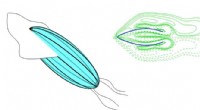
* Faster Source: As the source's speed increases, the wave crests begin to pile up in front of the object, forming a V-shape. The angle of the V becomes narrower as the source moves faster.
* Critical Speed: At a specific speed, called the critical speed, the source is moving exactly as fast as the wave speed. This is the point where the V-shape of the bow wave becomes sharpest, approaching a 90-degree angle.
* Supersonic Speed: When the source exceeds the critical speed, it's moving faster than the wave speed. This creates a "bow wave" where the V-shape is actually behind the source, forming a cone-shaped region of disturbance. This is similar to the sonic boom created by a supersonic aircraft.
Why the V-shape?
The V-shape is a result of the source "outrunning" the waves it creates. Think of it like this:
1. The source creates waves in all directions.
2. As the source moves forward, it's constantly creating new waves.
3. The waves behind the source have a longer distance to travel to catch up.
4. This creates a line of intersection between the waves, forming the V-shape.
Example:
* A slow-moving boat will have a wide, shallow V-shape to its bow wave.
* A speedboat will have a much narrower, sharper V-shape.
* A supersonic jet traveling faster than sound creates a cone-shaped shock wave behind it, which is a similar concept.
Key Takeaway:
The V-shape of a bow wave is a visual representation of the relationship between the speed of the source and the speed of the waves it creates. The sharper the V-shape, the faster the source is moving compared to the wave speed.