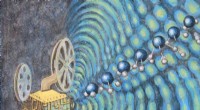
* Why the speed changes: The speed of a wave is determined by the properties of the medium it's traveling through. Think of it this way:
* Light: In denser materials (like glass), light interacts more with the atoms, slowing it down. In less dense materials (like air), light interacts less, moving faster.
* Sound: Sound travels faster in solids than in liquids and faster in liquids than in gases. This is because the molecules are closer together and can transmit vibrations more effectively.
* The effect of changing speed: When a wave enters a new medium where it travels at a different speed, its direction changes. This change in direction is called refraction.
Here's a simple analogy:
Imagine you're walking on a beach and you reach the water's edge. If you keep walking in a straight line, you'll change direction because the sand slows you down compared to the water. Similarly, a light wave slows down as it enters glass, causing it to bend.
The key point: The change in speed, not the change in density itself, is the reason for refraction. The density difference causes the speed difference, which in turn leads to the change in direction.
Key Concepts:
* Index of Refraction: This is a measure of how much a material slows down light. A higher index of refraction means light travels slower in that material.
* Snell's Law: This law describes the relationship between the angle of incidence (the angle at which the wave hits the interface), the angle of refraction (the angle at which the wave bends), and the indices of refraction of the two materials.
Let me know if you'd like a more detailed explanation of Snell's Law or any other aspect of refraction!