Here's why:
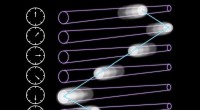
* Transverse waves involve oscillations that are perpendicular to the direction the wave travels. Think of a rope tied to a wall. If you shake the rope up and down, the wave travels horizontally along the rope, but the rope itself moves vertically.
* Longitudinal waves, on the other hand, involve oscillations that are parallel to the direction the wave travels. A sound wave is a good example of a longitudinal wave – the air molecules vibrate back and forth in the same direction the sound is traveling.
So, in a transverse wave, the energy is transferred perpendicular to the direction of the wave's motion.