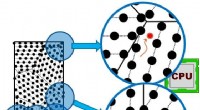
Here's what happens to the particles:
* Increased energy: The particles within the solid absorb enough energy (usually in the form of heat) to overcome the strong intermolecular forces holding them together in a fixed, rigid structure.
* Breaking free: The particles gain enough kinetic energy to break free from the solid lattice and escape into the surrounding space.
* Gaseous state: They become gaseous molecules, moving freely and randomly.
Think of it this way: Imagine a tightly packed group of people suddenly gaining the energy to jump up and disperse, leaving no one behind in the original group. That's similar to what happens to the particles during sublimation.
Examples of sublimation:
* Dry ice (solid carbon dioxide) subliming into carbon dioxide gas at room temperature.
* Freeze-dried foods being created through the sublimation of water ice.
* The slow disappearance of mothballs over time.
Let me know if you have any other questions!