Similarities:
* Wave-like behavior: All three types of waves exhibit characteristic wave phenomena like:
* Superposition: Waves can interfere with each other, resulting in constructive or destructive interference patterns.
* Diffraction: Waves can bend around obstacles.
* Reflection: Waves can bounce off surfaces.
* Refraction: Waves can change direction when passing from one medium to another.
* Energy and momentum transport: All waves carry energy and momentum.
Key Differences:
1. Nature of the wave:
* Mechanical Waves: These waves require a medium to propagate. They are caused by disturbances in a material medium (like air, water, or a solid). The disturbance propagates through the medium, transferring energy and momentum without transporting matter itself. Examples: sound waves, water waves, waves on a string.
* Electromagnetic Waves: These waves are self-propagating disturbances in electric and magnetic fields. They do not require a medium and can travel through a vacuum. Examples: light, radio waves, microwaves, X-rays.
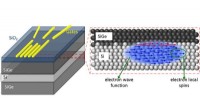
* Matter Waves: These are associated with the wave-like behavior of particles, specifically those with very small mass like electrons, photons, and atoms. The wave nature of matter is described by quantum mechanics. Examples: electron waves, neutron waves.
2. Speed of Propagation:
* Mechanical Waves: The speed of mechanical waves depends on the properties of the medium, like its density and elasticity.
* Electromagnetic Waves: The speed of electromagnetic waves in a vacuum is constant and is the speed of light (c). The speed can change in different mediums.
* Matter Waves: The speed of matter waves is related to the momentum of the particle. The higher the momentum, the faster the wave travels.
3. Description and Mathematical Representation:
* Mechanical Waves: Typically described using classical wave equations, which involve displacement and pressure variables.
* Electromagnetic Waves: Described by Maxwell's equations, which govern the behavior of electric and magnetic fields.
* Matter Waves: Described by the Schrödinger equation, which is a cornerstone of quantum mechanics and relates to the wave function of a particle.
In summary:
While all three types of waves share some common features, their underlying nature, mechanisms of propagation, and mathematical descriptions are distinct. Mechanical waves require a medium, electromagnetic waves are self-propagating disturbances in electric and magnetic fields, and matter waves describe the wave-like behavior of particles. Understanding these differences is crucial for appreciating the vast range of wave phenomena that exist in the universe.