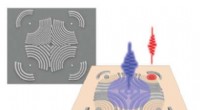
* Electron Spin: Electrons have a property called spin, which is a fundamental quantum property. Imagine it like the electron spinning on its axis, creating a tiny magnetic field.
* Electron Orbit: Electrons also orbit the nucleus of an atom. This orbital motion also generates a magnetic field.
* Net Magnetic Moment: In most atoms, the magnetic fields from different electrons cancel each other out. However, in some atoms, these fields don't fully cancel, creating a net magnetic moment.
Types of Magnetic Behavior:
* Paramagnetism: In paramagnetic materials, the atoms have a small, unpaired magnetic moment. These moments align themselves weakly with an external magnetic field, causing a slight attraction.
* Diamagnetism: In diamagnetic materials, the atoms have paired electrons, and their magnetic moments cancel out. They are weakly repelled by an external magnetic field.
* Ferromagnetism: In ferromagnetic materials, the atoms have unpaired electrons and their magnetic moments strongly align with each other, creating a large net magnetic moment. This is the type of magnetism seen in everyday magnets like those on refrigerators.
Key Points:
* It's the movement of electrons (spin and orbital motion) that gives rise to magnetic properties in atoms.
* Not all atoms exhibit magnetism. It depends on the arrangement of their electrons.
* The strength of the magnetic property varies depending on the material and the number of unpaired electrons.
So, while atoms themselves aren't magnets in the traditional sense, they can exhibit magnetic properties due to the behavior of their electrons.