Simple Harmonic Motion (SHM):
* Ideal Scenario: In a perfect vacuum, a simple pendulum would oscillate back and forth with a constant amplitude and period. This idealized motion is SHM.
* Period: The period of oscillation (time for one complete swing) depends only on the length of the pendulum and the acceleration due to gravity.
Damping:
* Air Resistance: Air molecules collide with the pendulum bob, creating a frictional force that opposes its motion. This force is known as air resistance or drag.
* Energy Loss: The air resistance causes the pendulum to lose energy with each swing, resulting in a gradual decrease in amplitude.
* Exponential Decay: The amplitude of the oscillation decays exponentially with time, meaning it decreases by a constant fraction in each time interval.
Key Characteristics of Damped SHM:
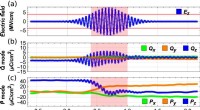
* Oscillatory Motion: The pendulum still oscillates, but the amplitude decreases over time.
* Decreasing Amplitude: The maximum displacement from equilibrium gets smaller with each swing.
* Constant Period: The time for one oscillation remains roughly constant, even as the amplitude decreases. This is true for light damping.
Factors Affecting Damping:
* Air Density: Higher air density leads to greater damping.
* Pendulum Bob Shape: A larger surface area or less aerodynamic shape increases damping.
* Pendulum Bob Speed: Greater speed results in stronger air resistance.
Visualizing the Motion:
Imagine a pendulum swinging back and forth. In a vacuum, its swings would be perfectly symmetrical and continuous. In air, the swings gradually become smaller until the pendulum eventually comes to rest.
In summary:
The motion of a simple pendulum in air is a combination of SHM and damping due to air resistance. The pendulum oscillates with a decreasing amplitude while maintaining a nearly constant period until it eventually comes to rest.