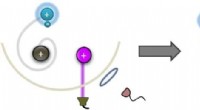
* Centripetal force is the force that keeps an object moving in a circular path. It always acts towards the center of the circle.
* Speed is the rate at which an object is moving along its circular path.
The key equation:
Centripetal force (Fc) = (mass of object (m) * velocity squared (v^2)) / radius of the circle (r)
From this equation, we can see:
* Directly proportional to speed squared: If you double the speed of an object, the centripetal force required to keep it moving in the same circle increases by a factor of four (2^2 = 4).
* Inversely proportional to the radius of the circle: If you increase the radius of the circle, the centripetal force required to keep the object moving at the same speed decreases.
In simpler terms:
* Higher speed requires more force: The faster an object moves in a circle, the stronger the force needed to keep it from flying off in a straight line (tangential to the circle).
* Larger circles require less force: If an object is moving at the same speed, a larger circle requires less force to maintain the circular motion.
Examples:
* Swinging a ball on a string: The faster you swing the ball, the more tension (centripetal force) you need to apply to the string.
* A car turning: The faster the car goes around a bend, the more force is needed from the tires (friction) to keep it on the curve.
Important Note: While the centripetal force is required to keep the object moving in a circle, it does not change the object's speed. It only changes the direction of the object's velocity.