Here's a breakdown:
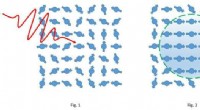
* Transverse waves: The particles in the medium oscillate perpendicular to the direction the wave travels. Think of a wave on a string. As the wave moves horizontally, the string particles move up and down, which is perpendicular to the wave's motion.
Examples of transverse waves:
* Light waves: These are electromagnetic waves, and their oscillations are perpendicular to the direction of propagation.
* Waves on a string: Like the example above, the string particles move perpendicular to the wave.
* Seismic S-waves (secondary waves): These waves travel through the Earth's interior and cause particles to move perpendicularly to the wave's direction.
Let me know if you'd like more information about waves!