1. Law of Inertia:
* Statement: An object at rest will stay at rest, and an object in motion will stay in motion at a constant velocity, unless acted upon by a net external force.
* Explanation: Objects naturally resist changes in their state of motion. Think of pushing a heavy box – it takes effort to get it moving, and then it keeps moving in a straight line unless something stops it.
2. Law of Acceleration:
* Statement: The acceleration of an object is directly proportional to the net force acting on it and inversely proportional to its mass.
* Explanation: A larger force produces a larger acceleration. A heavier object will accelerate less than a lighter object with the same force applied. This is represented by the equation: F = ma (Force = mass x acceleration)
3. Law of Action and Reaction:
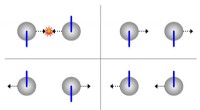
* Statement: For every action, there is an equal and opposite reaction.
* Explanation: When one object exerts a force on another object, the second object exerts an equal and opposite force on the first. Think of jumping – you push down on the ground, and the ground pushes back up on you with an equal force, launching you upwards.
Key Points:
* Applications: These laws are essential for understanding how everything from rockets to cars to even the planets in our solar system move.
* Limitations: Newton's laws are only applicable within certain limits. They don't work at very high speeds (close to the speed of light) or for very small objects (like atoms). These situations require more advanced theories like relativity and quantum mechanics.
Let me know if you have any more questions about Newton's Laws of Motion!