1. The Smashing:
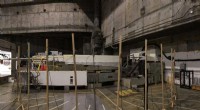
* Accelerating particles: Accelerators use powerful electromagnetic fields to accelerate charged particles (like protons or electrons) to nearly the speed of light.
* Collision: These highly energetic particles are then directed to collide with a target, which can be another beam of particles or a fixed target like a metal sheet.
* Energy transfer: The energy from the collision is not lost but transformed into new particles. It's like a cosmic game of pool, where the cue ball (the colliding particles) break apart the target particles into smaller pieces.
2. The Detective Work:
* Detecting the debris: Giant detectors surround the collision point to capture the particles produced in the collision. These detectors measure the properties of the particles, such as their charge, momentum, and energy.
* Analyzing the data: Scientists meticulously analyze the data collected by the detectors to look for patterns and signatures that indicate the presence of new particles.
* Identifying the new particles: This process involves comparing the observed data with theoretical predictions and looking for inconsistencies that might indicate the existence of something unknown.
How do they know it's a new particle?
* Unexpected behavior: New particles often leave a unique signature in the detector data that doesn't match the expected behavior of known particles. This could be unusual energy levels, decay patterns, or other distinctive characteristics.
* Theoretical predictions: Particle physicists have developed theories that predict the existence of new particles based on our understanding of the universe. When experimental data aligns with these predictions, it strengthens the case for the discovery of a new particle.
* Confirmation: Discovering a new particle is a rigorous process. The results need to be independently verified by multiple experiments and analyzed by various research groups before being widely accepted by the scientific community.
Examples of discoveries:
* Higgs Boson: The Large Hadron Collider (LHC) was crucial in finding the Higgs Boson, a particle that gives mass to other particles.
* Top Quark: The Tevatron accelerator at Fermilab in the United States was essential in discovering the Top Quark, one of the heaviest fundamental particles.
Particle accelerators are powerful tools that allow us to probe the fundamental nature of matter and energy, and they continue to be essential for discovering new particles and advancing our understanding of the universe.