The relationship between physics and technology is a symbiotic one, each driving the other forward in a constant cycle of innovation. Here's how they partner in progress:
Physics Fuels Technological Advancements:
* Understanding fundamental principles: Physics provides the bedrock of knowledge about the universe. From the laws of motion to electromagnetism and quantum mechanics, it allows us to understand how things work at their core. This understanding fuels the development of new technologies.
* Developing new materials and processes: Physics research often leads to the discovery of new materials with unique properties (like superconductors or advanced composites), enabling the creation of innovative technologies.
* Improving existing technologies: Physics principles are constantly applied to improve existing technologies, making them more efficient, powerful, and reliable. Think of lasers in medical imaging or semiconductors in modern electronics.
Technology Enhances Physics Research:
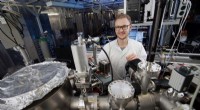
* Advanced tools and instruments: Technology provides physicists with powerful tools like particle accelerators, telescopes, and sophisticated sensors, pushing the boundaries of exploration and allowing them to delve deeper into the mysteries of the universe.
* Data analysis and simulations: Technological advancements in computing power and data analysis techniques allow physicists to analyze massive datasets and run complex simulations, helping them understand complex phenomena and test theoretical models.
* Real-world applications: Technology provides a platform for testing and validating physics theories in real-world scenarios, leading to a better understanding of the universe and its laws.
Examples of Physics and Technology Collaborations:
* Particle Physics and High-Energy Physics: The Large Hadron Collider (LHC) is a prime example of how technology pushes the limits of physics research. This massive particle accelerator, built through international collaboration, enables physicists to study the fundamental building blocks of matter.
* Astronomy and Space Exploration: Space telescopes like Hubble and James Webb Telescope, powered by advanced technology, are revolutionizing our understanding of the cosmos.
* Materials Science and Nanotechnology: Physics discoveries in quantum mechanics and materials science have paved the way for nanotechnology, leading to the development of new materials with unprecedented properties for use in electronics, medicine, and energy.
* Medical Imaging and Diagnostics: Medical imaging techniques like MRI and PET scans, based on physics principles, are crucial for diagnosis and treatment of diseases, improving healthcare outcomes.
The Future of Physics and Technology:
* Continued collaboration: This partnership will only grow stronger in the future. Advancements in quantum computing, artificial intelligence, and robotics will further propel both fields.
* Solving global challenges: Physics and technology will play a crucial role in addressing challenges like climate change, energy security, and food production.
In conclusion, physics and technology are intricately intertwined, each driving the other forward in a continuous cycle of progress. This partnership is essential for understanding the universe, solving global challenges, and creating a better future for humanity.