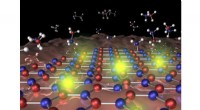
Thermal motion refers to the random, constant movement of atoms and molecules within a substance. It's the fundamental reason why matter exists in different states (solid, liquid, gas) and exhibits properties like temperature and heat.
Here's a breakdown:
1. The Source: Thermal motion is driven by heat energy. When a substance absorbs heat, its atoms and molecules gain kinetic energy, causing them to vibrate, rotate, and translate (move from one place to another).
2. Varying Levels: The intensity of thermal motion depends on the substance's temperature. Higher temperatures mean greater kinetic energy, leading to more vigorous movement.
3. States of Matter:
* Solid: Atoms and molecules in a solid are tightly packed and vibrate in fixed positions. They have limited translational motion.
* Liquid: Atoms and molecules in a liquid have more freedom to move around, allowing them to slide past each other.
* Gas: Atoms and molecules in a gas are widely spaced and move freely in all directions, colliding with each other and the container walls.
4. Importance: Thermal motion plays a crucial role in various phenomena:
* Diffusion: The spread of molecules from an area of high concentration to low concentration.
* Heat transfer: The flow of heat from a hotter object to a colder one.
* Chemical reactions: The movement of molecules affects reaction rates.
* Sound propagation: Sound waves travel through matter due to vibrations caused by thermal motion.
In essence, thermal motion is the invisible dance of matter, constantly happening at the microscopic level. It's the fundamental driving force behind many physical processes that we observe in the world around us.