Velocity vs. Speed
* Velocity: Velocity is a vector quantity, meaning it has both magnitude (speed) and direction.
* Speed: Speed is a scalar quantity, meaning it only has magnitude (how fast something is moving).
The Scenario
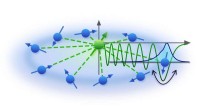
Imagine a particle moving in a circular path. Here's how it can have zero average velocity but a non-zero average speed:
1. Equal Time in Opposite Directions: The particle moves at a constant speed around the circle. For every half-circle it travels in one direction, it travels the same distance in the opposite direction.
2. Zero Displacement: Because the particle returns to its starting point, its overall displacement is zero.
3. Zero Average Velocity: Since velocity is displacement over time, and the displacement is zero, the average velocity is also zero.
4. Non-Zero Average Speed: The particle was moving at a constant speed throughout its journey, so its average speed will be the same as its constant speed.
In Summary
The key is that average velocity considers both distance *and* direction, while average speed only considers distance. If a particle moves in a way that results in zero displacement (like a round trip), its average velocity will be zero, even if it traveled at a constant speed.