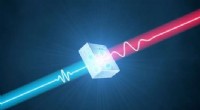
Phase velocity is the speed at which a specific point of constant phase of a wave, such as the crest or trough, propagates through a medium. Imagine a wave on the surface of water. The phase velocity is the speed at which a particular crest travels across the water's surface.
Here's a breakdown:
* Wave: A disturbance that travels through a medium, transferring energy but not necessarily matter.
* Phase: A specific point on a wave, defined by its position in the wave's cycle (e.g., crest, trough, zero crossing).
* Phase Velocity (v_p): The speed at which a point of constant phase moves through the medium.
Important Points:
* Not the speed of energy transfer: While phase velocity describes how fast the wave's shape moves, it doesn't necessarily represent the speed at which energy is transferred.
* Dependent on medium properties: Phase velocity is influenced by the properties of the medium through which the wave travels.
* Can exceed the speed of light: In some cases, like in certain dispersive media, phase velocity can exceed the speed of light. This doesn't violate Einstein's theory of special relativity because it doesn't involve the transfer of information or energy.
Formula:
The phase velocity (v_p) can be calculated using the following formula:
v_p = ω/k
where:
* ω is the angular frequency (in radians per second)
* k is the wave number (in radians per meter)
Applications:
Phase velocity is important in various fields, including:
* Telecommunications: Understanding phase velocity helps in designing efficient waveguides and transmission lines.
* Optics: The concept is crucial in analyzing the behavior of light waves in different materials.
* Geophysics: Phase velocity measurements are used to study the Earth's interior structure.
In simple terms:
Imagine throwing a stone into a pond. The ripples that spread outwards are waves. Phase velocity is the speed at which the crest of one of those ripples travels across the pond's surface.