Here's a breakdown of the principle:
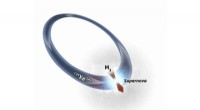
1. Magnetic Transmitter: The EM log emits a magnetic field into the surrounding seawater.
2. Seawater Movement: As the vessel moves through the water, the conductive seawater cuts through the magnetic field lines. This creates a voltage in the seawater due to Faraday's law of electromagnetic induction.
3. Magnetic Receiver: The EM log has a receiver that detects this induced voltage. The strength of the voltage is directly proportional to the speed of the vessel.
4. Speed Calculation: The EM log uses the measured voltage to calculate the vessel's speed.
Key Factors:
* Conductivity of Seawater: EM logs work best in saltwater, which has higher conductivity than freshwater.
* Magnetic Field Strength: The strength of the magnetic field emitted by the transmitter influences the accuracy of the speed measurement.
* Installation: The EM log needs to be installed in a location where the seawater flow is undisturbed, typically on the hull of the vessel.
Advantages of EM Logs:
* High Accuracy: EM logs are generally very accurate, especially at higher speeds.
* Non-Contact Measurement: They don't require physical contact with the seabed or other objects, making them suitable for various water depths.
* Low Maintenance: EM logs are relatively low-maintenance devices.
Limitations of EM Logs:
* Sensitivity to Magnetic Interference: They can be affected by external magnetic fields, such as those generated by power cables or nearby equipment.
* Limited Accuracy at Low Speeds: Accuracy may decrease at very low speeds, especially in freshwater.
In summary, electromagnetic speed logs use the principles of electromagnetic induction to measure the speed of a vessel through water by detecting the change in magnetic field caused by the movement of the conductive seawater. They are reliable instruments used in various maritime applications, particularly for accurate speed measurement.