* Both are mechanical waves: This means they require a medium (like air, water, or a solid) to travel through. They cannot travel through a vacuum.
* Both transfer energy: This is the primary function of waves. They move energy from one point to another without permanently transporting matter.
* Both exhibit wave characteristics: Both waves display properties like wavelength, frequency, amplitude, and speed.
* Both can be reflected and refracted: When a wave encounters a boundary or a change in medium, it can bounce back (reflection) or bend (refraction).
Let's look at the differences to better understand how these similarities make sense:
* Direction of particle motion vs. wave motion:
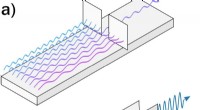
* Transverse waves: Particles in the medium move perpendicular to the direction the wave travels (like a rope being shaken up and down).
* Compressional waves: Particles in the medium move parallel to the direction the wave travels (like a slinky being pushed and pulled).
* Types of waves:
* Transverse waves: Light, radio waves, and some seismic waves are examples.
* Compressional waves: Sound waves and some seismic waves are examples.
In summary, although transverse and compressional waves move energy in different ways, they are both mechanical waves that share fundamental wave characteristics and can exhibit similar wave phenomena.