Here's how the particles in a water wave move:
* Water waves are transverse waves. This means the particles in the water move perpendicular to the direction the wave travels.
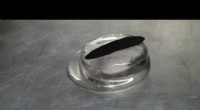
* The particles move in a circular path. Imagine a cork floating on the surface of the water. As a wave passes, the cork will bob up and down and slightly back and forth, tracing a circular path.
* The amplitude of the wave determines the diameter of the circles. A higher wave has a larger amplitude, and the particles move in larger circles.
* The deeper the water, the larger the circle. Particles at the surface have the largest circular motion. As you go deeper, the circles get smaller until they become negligible.
Key point: While the wave appears to be traveling across the surface of the water, the water itself isn't moving with the wave. The particles are just moving in a circular path, transferring energy from one particle to the next.