1. Semiconductor Material:
* The core of a semiconductor laser is a semiconductor material, typically a compound like gallium arsenide (GaAs) or indium phosphide (InP).
* These materials have a unique band structure where electrons can exist in two energy levels: the valence band (lower energy) and the conduction band (higher energy).
2. Pumping:
* To create laser light, electrons need to be excited to the conduction band. This is achieved by pumping the semiconductor material with energy.
* Pumping can be done by various methods:
* Electrical pumping: Applying an electric current to the semiconductor material.
* Optical pumping: Illuminating the material with light of a higher energy.
3. Population Inversion:
* When electrons are excited to the conduction band, they can fall back to the valence band, releasing energy in the form of light.
* However, to achieve laser action, a condition called population inversion is crucial. This means having more electrons in the excited state (conduction band) than in the ground state (valence band).
4. Stimulated Emission:
* Once population inversion is achieved, a photon (light particle) with the right energy can interact with an excited electron, causing it to drop back to the valence band and emit another photon with the same energy and phase.
* This is called stimulated emission. This emitted photon, in turn, can stimulate other excited electrons to emit photons, leading to a cascade of identical photons.
5. Optical Cavity:
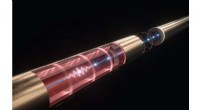
* To create a laser beam, the semiconductor material is enclosed in an optical cavity.
* This cavity consists of two mirrors, one highly reflective and one partially reflective.
* The emitted photons bounce back and forth between the mirrors, increasing the intensity of the light.
* The partially reflective mirror allows some of the light to escape, forming the laser beam.
6. Laser Light:
* The light emitted from a semiconductor laser is highly coherent (all photons have the same frequency and phase) and monochromatic (all photons have the same wavelength).
* This makes it useful in a wide range of applications, such as optical communications, laser pointers, barcode scanners, and laser surgery.
In summary:
The principle of a semiconductor laser involves creating a population inversion in a semiconductor material, using stimulated emission to amplify light, and then confining the light within an optical cavity to produce a coherent and monochromatic laser beam.