Solid:
* Particles are tightly packed together. They vibrate in fixed positions, but don't move around freely.
* Strong attractive forces hold the particles together. This gives solids their definite shape and volume.
* Example: Imagine the atoms in a solid like marbles packed in a box, vibrating slightly but not moving past each other.
Liquid:
* Particles are closer together than in gases, but not as tightly packed as in solids. They can move around each other, but are still attracted to each other.
* Weaker attractive forces than solids. This gives liquids their ability to flow and take the shape of their container, but still have a definite volume.
* Example: Think of the marbles in the box now having more space to move around, able to bump into each other and change positions.
Gas:
* Particles are far apart and move freely. They collide with each other and the walls of their container.
* Very weak attractive forces between particles. This is why gases expand to fill their container and have no fixed shape or volume.
* Example: Imagine the marbles in the box now flying around with lots of space between them, colliding with the sides of the box.
Plasma:
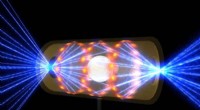
* A special state of matter where the atoms are ionized, meaning they have lost or gained electrons. This creates charged particles that are very energetic and move quickly.
* Can conduct electricity and be influenced by magnetic fields.
* Example: The sun is a giant ball of plasma.
The movement of particles is related to temperature. As temperature increases, particles move faster and have more energy. This explains why solids melt into liquids, and liquids boil into gases.
Here's a simple summary:
* Solid: Vibrate in place
* Liquid: Flow and move around each other
* Gas: Move freely and collide frequently
* Plasma: Highly energized and ionized particles
Keep in mind that this is a simplified explanation. The actual behavior of particles in matter is much more complex and involves quantum mechanics.