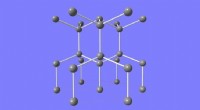
For atoms:
* Strong Nuclear Force: This is the strongest force in the universe and holds protons and neutrons together in the nucleus of an atom. It's short-range, meaning it only acts over extremely short distances.
* Electromagnetic Force: This force governs the interaction between charged particles, like protons and electrons. It attracts opposite charges and repels like charges. It's responsible for holding electrons in orbit around the nucleus.
For molecules:
* Covalent Bonds: These are strong bonds where atoms share electrons. This sharing creates a stable arrangement of atoms, forming a molecule.
* Ionic Bonds: These are bonds formed by the electrostatic attraction between oppositely charged ions. One atom donates an electron, becoming a positively charged ion, while the other atom gains an electron, becoming negatively charged.
* Metallic Bonds: These bonds occur between metal atoms. The electrons are delocalized and move freely throughout the metal, creating a strong attraction between the positively charged metal ions and the sea of electrons.
* Van Der Waals Forces: These are weak forces that arise from temporary fluctuations in electron distribution within molecules. They are responsible for holding molecules together in liquids and solids.
For larger structures:
* Hydrogen Bonds: These are a special type of dipole-dipole interaction between a hydrogen atom covalently bonded to a highly electronegative atom (like oxygen or nitrogen) and another highly electronegative atom. They play a crucial role in the structure of DNA and proteins.
* Hydrophobic Interactions: These interactions are driven by the tendency of nonpolar molecules to avoid water. They help to hold together nonpolar molecules in water.
It's important to note that the strength of these forces varies considerably, with the strong nuclear force being the strongest and the Van der Waals forces being the weakest. The types of forces present determine the physical and chemical properties of matter.