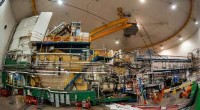
* Scale: Particles are incredibly small, far beyond the limits of our everyday vision and even most microscopes. Studying them requires powerful instruments like particle accelerators, which generate extremely high energies to probe the inner workings of matter.
* Interactions: Particles interact in complex ways, governed by the laws of quantum mechanics. These interactions are often probabilistic and require sophisticated theoretical models to analyze the experimental data.
* Short-lived: Many particles are unstable and decay very quickly. This makes observing and studying them difficult and requires specialized detectors designed to capture fleeting events.
* Exotic conditions: Some particles only exist in extreme conditions, such as high temperatures or pressures, which are challenging to create and maintain in a lab setting.
* Unification: The Standard Model of particle physics, our best understanding of the fundamental particles and forces, still has unanswered questions. It doesn't explain everything, such as the nature of dark matter and dark energy.
* Limited knowledge: We are constantly learning new things about particles and their interactions, which often leads to refining our understanding of the theory and requiring new experiments to test it further.
Despite these challenges, significant progress has been made in testing and refining the particle theory:
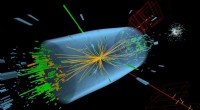
* Discovery of new particles: The discovery of particles like the Higgs boson and the top quark has strengthened the Standard Model.
* Precise measurements: Experiments have measured fundamental constants and particle properties with increasing precision, confirming theoretical predictions.
* New frontiers: Ongoing research in particle physics explores new frontiers, such as searching for supersymmetry and studying the properties of neutrinos.
The difficulty in testing the particle theory reflects its complexity and the immense scale of the universe we are trying to understand. This challenge drives scientists to develop ever-more powerful tools and innovative experiments, pushing the boundaries of human knowledge and understanding.