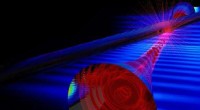
Factors affecting wave speed:
* Medium: The type of medium the wave travels through significantly impacts its speed. For example, sound travels faster in solids than in liquids, and faster in liquids than in gases.
* Temperature: Temperature affects the density and elasticity of the medium, influencing wave speed. Generally, waves travel faster in warmer media.
* Frequency: For some types of waves, like electromagnetic waves, the speed is constant in a vacuum (speed of light). However, in a medium, the speed of light can vary slightly with frequency, a phenomenon known as dispersion.
* Depth: For waves on the surface of water, the depth of the water influences wave speed. Waves travel faster in deeper water.
Examples:
* Sound waves: Sound travels faster in steel than in air.
* Light waves: Light travels slower in water than in air.
* Water waves: Waves on the surface of the ocean travel faster in deep water than in shallow water.
Exceptions:
* Electromagnetic waves in a vacuum: The speed of light in a vacuum is constant, regardless of the frequency of the wave. This is a fundamental constant in physics.
In summary:
While the speed of some waves can be considered constant in specific conditions, the speed of a wave is generally not constant and can vary depending on the medium, temperature, frequency, and other factors.