Hypothesis: Materials with free electrons will readily conduct electricity, while materials with bound electrons will resist the flow of electricity, acting as insulators.
Explanation:
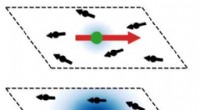
* Conductors: Materials like metals have a "sea" of free electrons that are not tightly bound to individual atoms. These free electrons can easily move and carry an electric current when a voltage is applied.
* Insulators: Materials like rubber, glass, and plastic have electrons tightly bound to their atoms. These electrons are not easily dislodged and cannot carry an electric current effectively.
This hypothesis can be further tested through experiments:
* Experiment 1: Measure the resistance of different materials when a voltage is applied. Conductors will show low resistance, allowing a large current flow, while insulators will show high resistance, limiting the current.
* Experiment 2: Observe the behavior of electrons in different materials using tools like electron microscopes or spectroscopy. Conductors will show a higher density of free electrons compared to insulators.
Conclusion: By observing the behavior of electrons and measuring the resistance of different materials, we can confirm or refute the hypothesis about the relationship between free electrons, bound electrons, and their conductivity properties.