1. Fundamental Tools:
* Mathematics: This is the language of physics. Physicists use calculus, linear algebra, differential equations, statistics, and more to model and analyze physical phenomena.
* Logic and Reasoning: Critical thinking, problem-solving skills, and the ability to deduce conclusions from evidence are essential for physicists.
* Scientific Method: Physicists rely on a systematic approach to understanding the world: observation, hypothesis, experiment, analysis, and conclusion.
2. Experimental Tools:
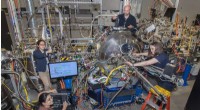
* Laboratory Equipment: This includes a wide range of instruments for measuring physical quantities like temperature, pressure, voltage, current, time, mass, length, etc. Examples include thermometers, pressure gauges, voltmeters, oscilloscopes, scales, rulers, and calipers.
* Advanced Instrumentation: For more complex research, physicists use sophisticated instruments like:
* Particle Accelerators: These machines accelerate particles to high energies to study their fundamental properties.
* Telescopes: Used to observe astronomical objects and gather information about the universe.
* Spectrometers: Analyze the frequencies of light or sound to identify the composition of materials.
* Microscopes: Allow visualization of objects too small to be seen by the naked eye.
* Lasers: Used for precise measurements, manipulating materials, and conducting experiments.
* Superconducting magnets: Used in MRI machines and particle accelerators to generate strong magnetic fields.
* Computers: Used for data analysis, simulations, and modeling. Powerful software packages are used for numerical calculations, data visualization, and theoretical modeling.
* Programming Skills: Physicists often need to write code to control experiments, analyze data, or develop theoretical models. Popular programming languages include Python, C++, and MATLAB.
3. Theoretical Tools:
* Mathematical models: Physicists develop and use mathematical equations to describe physical phenomena.
* Computer simulations: These allow physicists to test theoretical predictions and explore complex systems that are difficult or impossible to study experimentally.
* Analytical techniques: These include techniques for solving equations, analyzing data, and making predictions.
* Collaboration: Physicists often work in teams, sharing ideas and expertise to tackle complex problems.
4. Other Tools:
* Notebooks and journals: Physicists meticulously record their observations, experiments, and calculations.
* Whiteboards and presentation tools: Used for brainstorming, sharing ideas, and explaining concepts.
* Communication skills: Physicists need to be able to explain their research effectively to other scientists and the general public.
It's important to note that the tools a physicist uses will vary depending on their area of specialization, the type of research they are conducting, and the specific challenges they are facing.