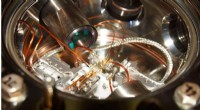
* Atoms: These are the fundamental building blocks of matter. They are incredibly small particles consisting of a nucleus (containing protons and neutrons) surrounded by a cloud of electrons.
* Molecules: These are formed when two or more atoms bond together. Water (H₂O), for example, is a molecule made of two hydrogen atoms and one oxygen atom.
Constant Motion:
Both atoms and molecules are in constant motion, even when the matter they make up appears still. Here's how:
* Thermal Energy: All matter has thermal energy, which is the energy associated with the random motion of atoms and molecules. The hotter the matter, the faster these particles move.
* Types of Motion:
* Translation: Atoms and molecules move from one place to another. This is most obvious in gases, where molecules are free to roam, but even solids have some translational motion.
* Rotation: Atoms and molecules can spin around their axes.
* Vibration: Atoms within molecules are constantly vibrating back and forth.
Examples:
* A glass of water: Water molecules are constantly moving around, translating, rotating, and vibrating.
* A piece of metal: The atoms in the metal are vibrating in their fixed positions within the solid structure.
* Air: Gas molecules are moving rapidly, colliding with each other and with the walls of their container.
Key Takeaway: Matter is made of tiny particles in constant motion, even when it appears still. The amount of motion is related to the temperature of the matter.