Here's how Einstein explained the photoelectric effect:
1. Light as photons: Einstein postulated that light consists of discrete packets of energy called photons, each with energy E = hν, where h is Planck's constant and ν is the frequency of light.
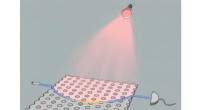
2. One photon, one electron: He proposed that when a photon strikes a metal surface, its energy is transferred to an electron within the metal.
3. Work function and kinetic energy: Each metal has a specific minimum energy, called the "work function" (Φ), needed to remove an electron from its surface. If the photon's energy (hν) exceeds the work function, the electron is emitted with excess kinetic energy (KE): KE = hν - Φ.
4. No photoelectric effect below threshold frequency: Einstein's theory explained why the photoelectric effect only occurs when the light frequency is above a certain threshold frequency (ν0). This threshold frequency corresponds to the work function of the metal (Φ = hν0).
Implications of Einstein's Explanation:
* Quantization of light: Einstein's theory provided strong evidence for the quantization of light and confirmed the particle nature of light.
* Explanation of experimental observations: It successfully explained the observed phenomena such as the threshold frequency, the linear relationship between kinetic energy and frequency, and the independence of the effect on the intensity of light.
* Foundation for quantum mechanics: His work laid the foundation for the development of quantum mechanics, which revolutionized our understanding of the universe at the atomic and subatomic levels.
Einstein's explanation of the photoelectric effect earned him the Nobel Prize in Physics in 1921 and solidified his place as one of the most influential physicists of all time. His revolutionary idea of light as both a wave and a particle continues to be a cornerstone of modern physics.