What is a wave?
* A wave is a disturbance that travels through a medium, transferring energy without transferring matter.
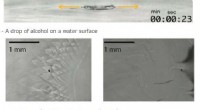
* Think of a ripple on a pond. The water doesn't travel across the pond, it just moves up and down.
How does a wave travel?
* Mechanical Waves: These waves need a medium to travel. They do this by transferring energy from one particle to the next. Imagine a line of dominoes: you push the first one, which knocks over the second, and so on. The dominoes themselves don't move far, but the disturbance (the knocking over) travels down the line.
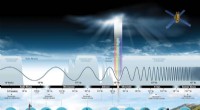
* Electromagnetic Waves: These waves don't require a medium. They are made of oscillating electric and magnetic fields that travel through space. Light is a type of electromagnetic wave.
Why does the medium stay in place?
* Particles Oscillate: The particles of the medium don't travel with the wave, they oscillate (move back and forth) around their equilibrium position.
* Energy Transfer: The energy of the wave is what travels, not the particles themselves.
Examples:
* Sound Waves: Sound travels through air as a series of compressions and rarefactions (regions of high and low pressure). Air molecules vibrate back and forth, but they don't travel with the sound wave.
* Water Waves: Water molecules move in a circular motion as a wave passes. They don't travel long distances; they just go up and down and back and forth.
Key takeaway:
The medium itself doesn't travel with the wave. It's the energy disturbance that propagates, causing the particles of the medium to oscillate.