1. Sound Waves are Longitudinal:
* Unlike light waves, which are transverse (vibrating perpendicular to the direction of travel), sound waves are longitudinal. This means the particles in the medium vibrate *parallel* to the direction the wave travels.
2. Compression and Rarefaction:
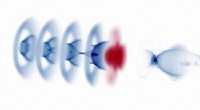
* A sound wave creates alternating regions of *compression* and *rarefaction* in the medium.
* Compression: The particles are squeezed together, increasing density.
* Rarefaction: The particles are spread apart, decreasing density.
3. Particle Oscillation:
* Individual particles don't actually travel long distances with the sound wave. Instead, they oscillate back and forth around their equilibrium position.
* In compression zones, the particles are pushed closer together, causing them to vibrate with greater amplitude (larger back-and-forth movement).
* In rarefaction zones, the particles are pulled further apart, vibrating with smaller amplitude.
4. Energy Transfer:
* The energy of the sound wave is transferred through the medium by the collisions of these oscillating particles.
* As one particle vibrates, it collides with its neighboring particle, transferring energy. This collision then causes the neighboring particle to vibrate, and so on.
Think of it like this:
Imagine a line of people holding hands. If you push the first person forward, they will push the next person, who will push the next, and so on. The "wave" of movement travels down the line, but each individual person only moves back and forth a little bit. This is similar to how sound waves work, with the "push" being the compression and the "pull" being the rarefaction.
Important Points:
* Medium Required: Sound waves need a medium (like air, water, or solids) to travel. There is no sound in a vacuum.
* Speed Varies: The speed of sound depends on the properties of the medium, such as temperature and density. Sound travels faster in denser and warmer mediums.
Let me know if you'd like more details on a specific aspect of sound waves!