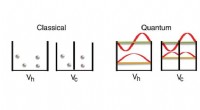
Here's a breakdown:
* Thermal energy: The energy possessed by a particle due to its temperature. Higher temperatures mean more thermal energy and faster particle motion.
* Random motion: Electrons in a material don't all move at the same speed or in the same direction. Their movement is random, constantly changing due to collisions with other particles.
* Average speed: While individual electron speeds vary, we can talk about their average speed, which is the thermal velocity.
Here's why thermal velocity is important:
* Electrical conductivity: In metals, electrons are free to move, and their thermal velocity plays a role in how easily they conduct electricity. A higher thermal velocity means electrons are moving faster and can carry electrical current more efficiently.
* Diffusion: Thermal velocity contributes to diffusion, the movement of particles from areas of high concentration to low concentration. This process is important in many chemical and physical phenomena.
* Plasma physics: In plasmas, where electrons are free to move in a gas, thermal velocity is crucial for understanding the behavior of the plasma and its interactions with electromagnetic fields.
How to calculate thermal velocity:
The thermal velocity of an electron can be calculated using the following formula:
```
v_th = √(3kT/m)
```
Where:
* v_th is the thermal velocity
* k is the Boltzmann constant (1.38 × 10^-23 J/K)
* T is the temperature in Kelvin
* m is the mass of the electron (9.11 × 10^-31 kg)
Key points to remember:
* Thermal velocity is an average speed, and individual electrons can have speeds higher or lower than this value.
* Thermal velocity is directly proportional to the square root of temperature, meaning higher temperatures lead to higher thermal velocities.
* Thermal velocity is inversely proportional to the square root of the electron's mass.
Understanding thermal velocity is essential for understanding the behavior of electrons in materials and the various phenomena they contribute to.