Here's a breakdown:
* Light (electromagnetic radiation) is composed of tiny packets of energy called photons.
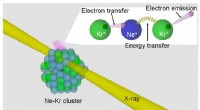
* When a photon strikes a metal surface, it can transfer its energy to an electron in the metal.
* If the photon's energy is high enough (above a certain threshold value called the work function of the metal), the electron can overcome the forces holding it within the metal and be ejected.
* These ejected electrons are called photoelectrons.
The photoelectric effect is a fundamental concept in quantum mechanics and has many applications, such as in photomultipliers, solar cells, and light detectors.