Here's why:
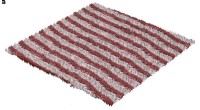
* Transverse waves: The particles of the medium move perpendicular to the direction the wave travels. Imagine a rope tied to a post. If you shake the rope up and down, you create a wave that travels along the rope, but the individual points on the rope move up and down (perpendicular to the wave's direction).
* Circular motion: In a transverse wave, the motion of the individual particles of the medium is not strictly up and down. It's more like a small circular motion. Think of a water wave. The water particles move in a circular path as the wave passes by.
Important Note: Not all transverse waves exhibit this exact circular motion. For example, electromagnetic waves (light, radio waves) are transverse, but they don't involve a physical medium with particles.