1. Waves Traveling in Opposite Directions:
Imagine two waves, let's call them Wave A and Wave B, traveling in opposite directions along the same medium (like a string or air). They have the same frequency (how often they oscillate) and amplitude (how high they reach).
2. Interference:
As these waves meet, they overlap. At some points, the crests of Wave A coincide with the crests of Wave B, resulting in constructive interference. This creates a larger amplitude, causing the medium to oscillate with greater displacement.
3. Nodes and Antinodes:
At other points, the crest of Wave A coincides with the trough of Wave B, resulting in destructive interference. This cancels out the amplitude, causing the medium to remain stationary. These points of zero displacement are called nodes. The points of maximum displacement (where constructive interference occurs) are called antinodes.
4. The Standing Wave Pattern:
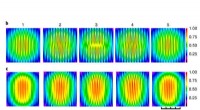
The result of this interference is a stationary wave pattern, called a standing wave. This pattern appears to stand still, even though the individual waves that created it are still moving.
Why does this happen?
The reason for this seemingly stationary wave pattern is that the two waves are perfectly synchronized. The crests and troughs of the two waves always meet at the same points, creating a consistent pattern of constructive and destructive interference.
Examples:
* Stringed instruments: Plucking a string on a guitar or violin creates standing waves along the string.
* Sound waves in a pipe: Blowing into a pipe can create standing waves of sound, which produce the different notes of a musical instrument.
* Microwave ovens: Microwaves are used to heat food by creating standing waves within the oven cavity.
Key points to remember:
* Standing waves are produced by the interference of two waves traveling in opposite directions.
* The waves must have the same frequency and amplitude.
* Standing waves have nodes (points of zero displacement) and antinodes (points of maximum displacement).
* The pattern of nodes and antinodes is stationary, even though the individual waves are still moving.
Hope this explanation helps!