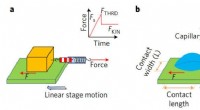
1. Start it moving: This is the most common way a force affects a resting object. When a force is applied to a stationary object, it will cause the object to accelerate. Acceleration means a change in velocity, which means the object will start moving.
* Example: Pushing a box: When you push a box, you apply a force to it. This force overcomes the friction between the box and the ground, causing the box to move.
2. Change its shape: Forces can also deform an object, changing its shape without necessarily causing it to move.
* Example: Pressing a sponge: When you press on a sponge, you apply a force that compresses the sponge, changing its shape.
Important Concepts:
* Newton's First Law of Motion: An object at rest will stay at rest, and an object in motion will stay in motion at a constant speed and direction, unless acted upon by a net force.
* Net Force: The overall force acting on an object. If the net force is zero, the object will stay at rest or continue moving at a constant velocity.
In summary, a force can affect an object at rest by making it move or by changing its shape. The effect of the force depends on the magnitude and direction of the force, as well as the mass and properties of the object.