* As the mass of either object increases, the gravitational force between them also increases.
* The more massive the objects, the stronger the gravitational pull between them.
This relationship is described by Newton's Law of Universal Gravitation:
F = G * (m1 * m2) / r²
Where:
* F is the gravitational force between the two objects
* G is the gravitational constant (approximately 6.674 × 10⁻¹¹ N⋅m²/kg²)
* m1 and m2 are the masses of the two objects
* r is the distance between the centers of the two objects
Key points to remember:
* The force of gravity is always attractive, meaning it pulls objects towards each other.
* Gravity acts over any distance, although it weakens rapidly with increasing distance.
* The gravitational force between two objects depends on their masses and the distance between them.
Examples:
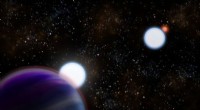
* The Earth and the Moon exert a gravitational force on each other, which is what keeps the Moon in orbit around the Earth.
* The Sun's large mass exerts a strong gravitational pull on all the planets in our solar system, keeping them in orbit.
In summary, the more massive the objects, the stronger the gravitational force between them. This relationship is fundamental to understanding the universe and how objects interact with each other.