Particle Accelerators:
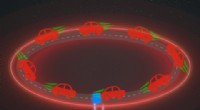
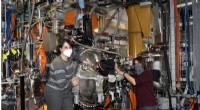
* The most famous example is the Large Hadron Collider (LHC). This massive machine accelerates protons to nearly the speed of light (99.9999991% to be precise). This speed is so incredible that it takes light only 15 microseconds to travel the entire circumference of the LHC!
* Other accelerators, like the Stanford Linear Accelerator Center (SLAC) and the Fermilab Tevatron, have also achieved similar speeds with various particles.
* Purpose: These machines aren't built to transport people. Instead, they help physicists study the fundamental building blocks of matter and the forces that govern the universe.
Spacecraft:
* The Parker Solar Probe is the fastest man-made object ever created. It's currently orbiting the sun at a speed exceeding 430,000 mph (700,000 km/h).
* Other spacecraft like Voyager 1 and 2 have achieved incredibly high speeds as they journey through the solar system.
* Purpose: These spacecraft explore our solar system and beyond, sending back valuable scientific data.
Challenges to High-Speed Travel for Humans:
* G-forces: Traveling at extremely high speeds would subject humans to immense G-forces, which can be fatal.
* Energy requirements: Reaching and maintaining those speeds would require vast amounts of energy, making it incredibly expensive and potentially unsustainable.
* Safety concerns: High-speed collisions would be catastrophic.
The Future of High-Speed Travel:
* Hypersonic aircraft are being developed, aiming to reach speeds of Mach 5 or higher (five times the speed of sound).
* Space tourism is becoming a reality, with companies like Virgin Galactic and SpaceX offering suborbital and orbital flights.
* Research into advanced propulsion systems like fusion drives could lead to even faster and more efficient space travel in the future.
While we haven't quite reached the point of sending humans at near-light speeds, the scientific advancements in particle accelerators and spacecraft development showcase the potential of physics to unlock new frontiers in transportation.