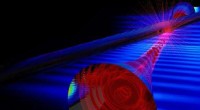
In essence, a particle collision is the act of two or more particles coming into close proximity and interacting with each other. This interaction can be simple, like two billiard balls bouncing off each other, or incredibly complex, like the smashing of protons in a particle accelerator.
What happens during a collision?
* Energy Transfer: The most important aspect of a collision is the exchange of energy between the particles. This can involve changes in momentum, kinetic energy, and even the transformation of mass into energy, as described by Einstein's famous equation E=mc².
* Particle Creation and Annihilation: Depending on the energy involved, new particles can be created during a collision. Conversely, existing particles can be annihilated, their mass converted into energy.
* Fundamental Forces: The interactions between particles during collisions are governed by the fundamental forces of nature: the strong force, weak force, electromagnetic force, and gravitational force.
Types of Particle Collisions:
* Elastic Collisions: These collisions conserve both momentum and kinetic energy. Think of a perfectly elastic ball bouncing off a wall.
* Inelastic Collisions: These collisions conserve momentum but not kinetic energy. Some energy is lost to heat, sound, or deformation of the particles.
* High-Energy Collisions: These collisions occur at very high energies, such as those in particle accelerators. They can lead to the creation of exotic particles and provide insights into the fundamental nature of matter.
Where do particle collisions happen?
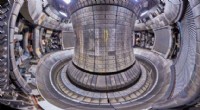
* Particle Accelerators: These machines are designed to accelerate particles to high energies and collide them with each other or with stationary targets. Examples include the Large Hadron Collider (LHC) and the Stanford Linear Accelerator Center (SLAC).
* Cosmic Rays: High-energy particles from outer space collide with atoms in Earth's atmosphere, creating showers of secondary particles.
* Nuclear Reactors: Collisions between neutrons and atomic nuclei are crucial for the nuclear fission process, which generates energy in nuclear power plants.
Why study particle collisions?
Particle collisions are a powerful tool for studying the fundamental building blocks of the universe. By analyzing the products of collisions, scientists can:
* Discover new particles: The discovery of the Higgs boson at the LHC is a prime example.
* Test theoretical models: Particle collisions provide experimental data that can be used to verify and refine our understanding of physics, such as the Standard Model of particle physics.
* Explore the early universe: Conditions in particle collisions can mimic those in the early universe, providing insights into the evolution of our cosmos.
In conclusion, particle collisions are a fascinating and powerful window into the world of the very small, revealing the secrets of matter and energy at their most fundamental level.