1. Reflection:
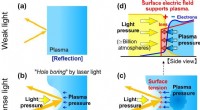
* Definition: When a wave encounters a boundary between two media, it can be reflected back into the original medium.
* Examples:
* A mirror reflecting light.
* Sound waves bouncing off a wall.
* Ocean waves reflecting off a seawall.
* Key factors: The angle of incidence (the angle at which the wave hits the boundary) and the properties of the two media determine the angle of reflection.
2. Refraction:
* Definition: When a wave passes from one medium to another, it changes direction due to the change in its speed.
* Examples:
* A straw appearing bent when placed in a glass of water (light refracting from air to water).
* A wave passing from shallow water to deep water, changing its direction.
* Key factors: The speed of the wave in each medium and the angle of incidence determine the angle of refraction.
3. Diffraction:
* Definition: The spreading of waves as they pass through an opening or around an obstacle.
* Examples:
* Light passing through a narrow slit, creating a pattern of bright and dark bands.
* Sound waves bending around a corner, allowing you to hear someone talking even if they are hidden from view.
* Key factors: The size of the opening or obstacle relative to the wavelength of the wave determines the extent of diffraction.
4. Interference:
* Definition: The superposition (combination) of two or more waves, resulting in a new wave pattern.
* Examples:
* Two waves interfering to create constructive interference (amplitudes add up, resulting in a larger wave) or destructive interference (amplitudes cancel out, resulting in a smaller or zero wave).
* Ripples in a pond overlapping to create interference patterns.
* Key factors: The phase difference (relative position) and amplitudes of the interfering waves determine the resulting pattern.
5. Absorption:
* Definition: The process where a wave loses energy as it passes through a medium.
* Examples:
* A dark surface absorbing light energy, getting warmer as a result.
* Sound waves being absorbed by a thick carpet, reducing noise levels.
* Key factors: The properties of the medium (e.g., color, density) and the frequency of the wave determine how much energy is absorbed.
6. Transmission:
* Definition: The passage of a wave through a medium without significant absorption or reflection.
* Examples:
* Light passing through a window pane.
* Radio waves traveling through the atmosphere.
* Key factors: The transparency of the medium and the frequency of the wave determine how much energy is transmitted.
7. Doppler Effect:
* Definition: The apparent change in frequency of a wave due to the relative motion between the source of the wave and the observer.
* Examples:
* The pitch of an ambulance siren changing as it approaches and then moves away from you.
* Redshift and blueshift of light from distant stars due to their motion relative to Earth.
* Key factors: The speed and direction of the source and observer determine the change in frequency.
These are just some examples of the ways waves interact with matter. The specific effects observed depend on the type of wave, the properties of the matter, and the conditions of the interaction. Understanding these interactions is crucial in many fields, including optics, acoustics, seismology, and astrophysics.