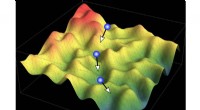
* Solid particles are tightly packed: They are held together by strong forces of attraction, forming a rigid structure.
* Vibration is the key: While they can't move freely around, the particles in a solid constantly vibrate. Think of them as jiggling or shaking in place.
* Temperature and vibration: The higher the temperature of a solid, the more the particles vibrate. At very high temperatures, the vibrations can become so strong that the solid melts into a liquid.
Here's a simple analogy: Imagine a crowded dance floor. People are close together and can't move freely, but they can still shake, wiggle, and move their arms and legs.
So, while particles in a solid can't change position in the same way as in liquids and gases, they do have movement - it's just confined to vibrations.