Wave-like Properties of Light:
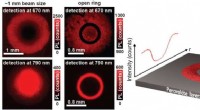
* Diffraction: Light bends around obstacles, creating interference patterns, which is characteristic of wave behavior.
* Interference: When two light waves meet, they can interfere with each other, creating areas of constructive and destructive interference, further supporting its wave nature.
* Polarization: Light waves can be polarized, meaning their oscillations are confined to a specific plane, indicating a transverse wave property.
* Electromagnetic Spectrum: Light is part of the electromagnetic spectrum, which includes various forms of radiation like radio waves, microwaves, and X-rays, all of which exhibit wave-like behavior.
Particle-like Properties of Light:
* Photoelectric Effect: When light shines on a metal surface, electrons are ejected. The energy of the ejected electrons depends on the frequency of the light, not its intensity. This suggests that light is made up of discrete packets of energy called photons, which can interact with electrons as particles.
* Compton Scattering: When X-rays scatter off electrons, they lose energy, and their wavelength changes. This can be explained by treating the X-rays as particles (photons) colliding with electrons.
* Blackbody Radiation: The spectrum of light emitted by a hot object cannot be explained by classical physics alone. It requires the quantization of light energy, implying that light exists in discrete packets of energy.
The Wave-Particle Duality:
Light is not simply a wave or a particle, but rather exhibits both properties depending on the situation. This duality arises from the quantum nature of light. Here's the key takeaway:
* Wave-like behavior: Light behaves like a wave when it propagates through space and interacts with large objects.
* Particle-like behavior: Light behaves like a particle when it interacts with matter on a smaller scale, like individual atoms or electrons.
The wave-particle duality of light is a fundamental concept in quantum mechanics, challenging our classical understanding of the world. It emphasizes that our everyday perception of objects as waves or particles is a simplification, and the true nature of reality is far more complex.