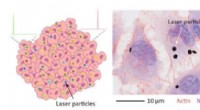
* Light Microscope: The resolving power is limited by the wavelength of light. The best light microscopes can resolve details down to about 200 nanometers (nm).
* Electron Microscope: The resolving power is determined by the wavelength of the electron beam. Because electrons have a much shorter wavelength than light, electron microscopes can achieve resolutions of 0.1 to 0.2 nanometers (nm).
Types of Electron Microscopes and their Resolving Power:
* Transmission Electron Microscope (TEM): Typically achieves resolutions in the range of 0.1 to 0.2 nm.
* Scanning Electron Microscope (SEM): Usually has a slightly lower resolving power than TEM, typically around 1 to 10 nm.
Important Notes:
* The actual resolving power achieved in practice can be influenced by factors such as the quality of the microscope, the sample preparation, and the imaging conditions.
* Electron microscopes are used to visualize extremely small objects, including viruses, atoms, and the internal structures of cells.
In essence, the resolving power of an electron microscope is hundreds of times higher than that of a light microscope, making it an invaluable tool for exploring the nanoscale world.