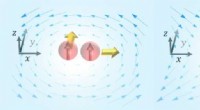
* Transverse Waves: Transverse waves involve oscillations that are perpendicular to the direction of wave propagation. Think of a wave on a string, where the string moves up and down (perpendicular) while the wave travels horizontally.
* Air as a Medium: Air is a fluid and can support both longitudinal and transverse waves.
* Electromagnetic Waves: Electromagnetic waves (like light) are transverse waves that can travel through a vacuum (like space) but also through air. They do not require a physical medium to propagate.
Examples of Transverse Waves in Air:
* Light Waves: The visible light we see, as well as other parts of the electromagnetic spectrum, are transverse waves that travel through air.
* Surface Waves: If you create a ripple on the surface of a still pond, this is a transverse wave, and a similar type of transverse wave can occur on the surface of air under certain conditions (like with wind gusts).
Important Note: While transverse waves can exist in air, they are not the most common type of wave in this medium. Sound waves, for example, are longitudinal waves where the oscillations of air molecules are parallel to the direction of wave propagation.