Here's a breakdown:
* Wavelength: The distance between two successive crests or troughs of a wave. It is measured in units like meters (m) or nanometers (nm).
* Frequency: The number of waves that pass a fixed point in one second. It is measured in Hertz (Hz), which represents cycles per second.
The relationship between them is defined by the following equation:
c = λf
Where:
* c is the speed of light in a vacuum (approximately 299,792,458 meters per second)
* λ is the wavelength
* f is the frequency
Here's how it works:
* Higher frequency: A wave with a higher frequency has more cycles passing a point per second. This means the waves are packed closer together, resulting in a shorter wavelength.
* Lower frequency: A wave with a lower frequency has fewer cycles passing a point per second. This means the waves are spread further apart, resulting in a longer wavelength.
Example:
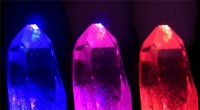
* Red light has a longer wavelength (around 700 nm) and a lower frequency compared to blue light, which has a shorter wavelength (around 450 nm) and a higher frequency.
In essence:
* Wavelength describes the *size* of a wave.
* Frequency describes the *rate* at which the waves are passing a point.
Their inverse relationship is a fundamental aspect of wave physics and is essential for understanding the nature of light.