Fields:
* Imagine a field as a region of space that is influenced by a particular force.
* This field is not something you can physically touch, but it represents the potential for a force to act on an object.
* There are various types of fields, such as gravitational fields, electric fields, and magnetic fields.
How Field Forces Work:
1. Source: Each force originates from a source, like a massive object (gravity), a charged particle (electric), or a magnet (magnetic).
2. Field Creation: The source creates a field around itself that extends into the surrounding space.
3. Interaction: When another object enters this field, it experiences a force. The strength and direction of this force depend on the type of field, the strength of the source, and the position of the object within the field.
Examples:
* Gravity: Earth creates a gravitational field around itself. Objects near the Earth experience a force of gravity pulling them towards the center.
* Magnetism: A magnet creates a magnetic field around itself. Another magnet or a piece of ferromagnetic material placed within this field will experience a force either attracting or repelling it.
* Electricity: Charged particles like electrons and protons create electric fields around themselves. When another charged particle enters this field, it will experience an electrostatic force, either attracting or repelling it.
Key Points:
* No Physical Contact: The force is exerted through the field, not by direct physical contact.
* Field Strength: The strength of the field decreases with distance from the source.
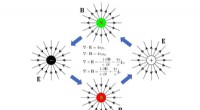
* Field Lines: We often visualize fields using field lines, which represent the direction of the force on a test object placed at a given point in the field.
Conclusion:
The concept of field forces provides a powerful way to understand how objects can interact without touching. It helps us understand phenomena like gravity, magnetism, and electricity, which are essential to our understanding of the universe.