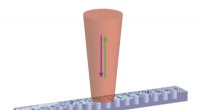
* Atoms in solids don't vibrate in isolation. They are constantly interacting with their neighbors, creating a collective motion that is better described as vibrations within a lattice.
* The frequency of these vibrations depends on multiple factors:
* Temperature: Higher temperatures lead to more intense vibrations.
* Material: The type of material and its bonding structure strongly influence vibration frequency.
* Specific atom: Even within the same material, different atoms will vibrate at slightly different frequencies.
* We can't measure the vibration of a single atom directly. Instead, we study the collective vibrations of a material as a whole, which can be measured using techniques like infrared spectroscopy or neutron scattering.
So, what can we say?
* Vibrations in solids are a key aspect of their behavior. They are responsible for phenomena like heat capacity, thermal conductivity, and even the strength of materials.
* The frequencies of these vibrations are generally very high. They are in the range of terahertz (THz), which is far beyond what our senses can perceive.
Instead of focusing on a single atom, it's more helpful to think about the range of frequencies present in a solid material. This range is often called the phonon spectrum, and its shape and characteristics are directly related to the material's physical properties.