1. Using the wave equation:
* For any wave: The fundamental equation relating wave speed (v), frequency (f), and wavelength (λ) is: v = fλ
* Frequency (f): This is the number of wave crests that pass a point per second, measured in Hertz (Hz).
* Wavelength (λ): This is the distance between two consecutive wave crests, measured in meters (m).
* Example: If you measure the frequency of a wave to be 10 Hz and its wavelength to be 0.5 meters, the wave speed is v = 10 Hz * 0.5 m = 5 m/s.
2. Measuring the time it takes to travel a known distance:
* For any wave: You can directly measure the time (t) it takes for a wave to travel a certain distance (d). The speed is then calculated as: v = d/t
* Example: If you observe a wave traveling 10 meters in 2 seconds, the speed is v = 10 m / 2 s = 5 m/s.
3. Using specific properties of the wave:
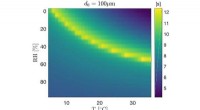
* For sound waves: The speed of sound in air depends on the temperature: v = 331.4 + 0.6T (where T is the temperature in Celsius).
* For light waves: The speed of light in a vacuum is a constant: c = 299,792,458 m/s. In other mediums, light travels slower, and the speed depends on the refractive index of the medium.
* For waves on a string: The speed depends on the tension (T) of the string and its linear density (μ): v = √(T/μ).
Important Considerations:
* Type of wave: Different types of waves have different properties and speed-determining factors.
* Medium: The speed of a wave can vary depending on the medium it travels through. For example, sound travels faster in solids than in liquids or gases.
* Accuracy: The accuracy of your measurements will affect the accuracy of your calculated speed.
Example Scenarios:
* Ocean waves: You can measure the time it takes for a wave crest to travel between two buoys a known distance apart.
* Sound waves: You can use a microphone and a computer to measure the time it takes for a sound wave to travel from a source to a detector.
* Light waves: You can use a laser and a detector to measure the time it takes for light to travel a certain distance.
By using these methods and considering the specific characteristics of the wave, you can effectively determine the speed of a wave.